
What New Sustainability Laws Mean for Your Marketing

The UK and Europe have introduced a raft of new laws that make sustainability claims in marketing a serious legal matter, not just a reputational one. Fines are now real. Enforcement is active. And the bar for what counts as a "substantiated" claim is higher than most marketing teams realise.
Here's what you need to know, and what you need to do about it.
What's Changed: The UK Picture
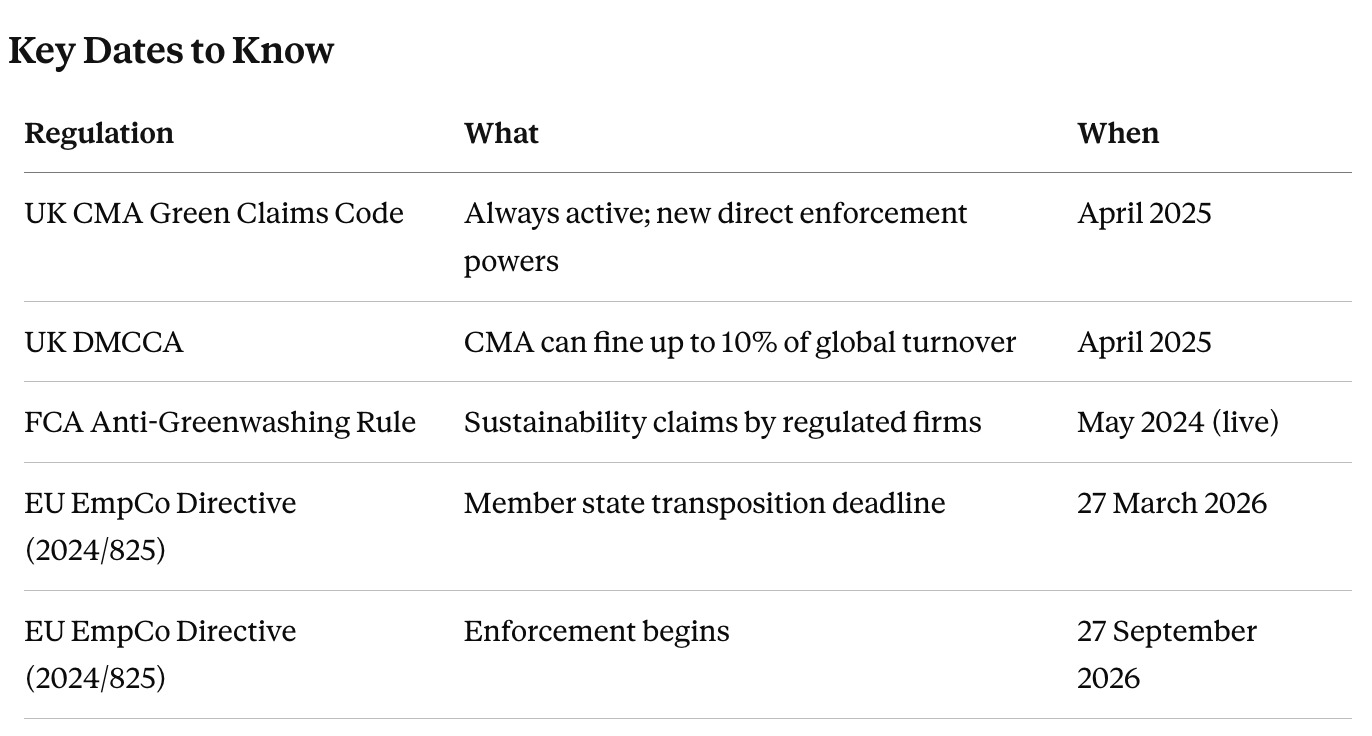
The Competition and Markets Authority (CMA) has always had its Green Claims Code - six principles for making environmental claims honestly. What changed in April 2025 is that the CMA now has the power to enforce consumer law directly, without needing to go through the courts first.
Under the Digital Markets, Competition and Consumers Act 2024 (DMCCA), the CMA can investigate, fine, and sanction brands for misleading green claims. Fines can reach £300,000 or 10% of global annual turnover - whichever is higher.
The CMA has said it will focus first on the worst breaches - objectively false claims - but the direction of travel is clear. Vague, unsubstantiated, and incomplete claims are firmly in scope.
What counts as a problem claim?
"Eco-friendly" with no qualification or proof
"Sustainable" as a general brand descriptor
Carbon neutral claims without methodology disclosed
Partial claims (e.g. "100% recycled bottle" when the cap and label aren't)
Future commitments stated as current fact
The FCA's Anti-Greenwashing Rule (May 2024)
If you work with any FCA-regulated financial services clients, this is already live. Since 31 May 2024, all sustainability claims made by regulated firms must be fair, clear, and not misleading - and must be substantiated with evidence. Fund naming and marketing rules followed in December 2024.
This matters beyond financial services too, because it sets the tone for how "substantiated" will be interpreted across sectors.
What's Changed: The European Picture
The Empowering Consumers Directive - EmpCo (EU 2024/825)
This directive is now the main event in Europe after the EU Green Claims Directive was withdrawn in 2025 (pulled due to concerns about the compliance burden on micro-enterprises). EmpCo amends the EU's Unfair Commercial Practices Directive and introduces hard rules for B2C sustainability communications.
Member states must transpose it by 27 March 2026, with enforcement kicking in from 27 September 2026. If you sell into European markets - or work with brands that do - this is your next hard deadline.
What EmpCo bans outright:
Generic claims like "eco-friendly", "green", "natural", "conscious" with no substantiation
"Carbon neutral" or "net zero" claims based on offsetting alone, with no transparency on methodology
Environmental claims about future performance unless backed by a verifiable, time-bound plan with measurable targets
Sustainability labels that aren't based on approved certification schemes or set by public authorities
The underlying principle is simple: if you say it, you have to be able to prove it - and the proof needs to be accessible to the consumer.
What This Means for Your Communications
1. Audit every green claim in your current comms
Start with a full sweep: website copy, social bios, packaging, email footers, campaign headlines, product descriptions. Flag anything that makes a sustainability claim - however incidental it seems.
Ask of each claim:
Is this specific or generic?
Do we have evidence for it right now?
Does it reflect the whole product/service, or just part of it?
If it's a future commitment, is it backed by a verified plan?
2. Review language
"Sustainable", "eco-friendly", "green", "responsible", "conscious", "better for the planet" - these terms are now legally risky unless you can back them up with specific, verifiable data. In many cases, you're better off replacing them with precise, qualified statements.
Instead of: "Our packaging is eco-friendly." Try: "Our outer packaging is made from 80% post-consumer recycled card. We're working to extend this to our mailers by Q3 2026."
3. Future claims need a plan, not just intent
Saying "we're committed to net zero by 2040" is no longer enough. You need to be able to show:
What your baseline emissions are
What your reduction pathway looks like
What verified commitments you've made (e.g. Science Based Targets)
What you're reporting against, and how often
If you can't show the plan, don't make the claim.
4. Labels and certifications need to be legitimate
Third-party eco labels are still useful - but only if they're backed by a recognised certification body or a public authority scheme. Homegrown badges and self-certified icons are a red flag under EmpCo. If you're using a label, be ready to explain exactly what it covers and who verified it.
The Data You Need to Have Ready
This is the part many brands aren't prepared for. Good intentions aren't evidence. Here's what you should be pulling together:
For product or packaging claims:
Life cycle assessment (LCA) data, or at minimum a credible partial assessment
Material composition data by weight/percentage, including packaging components
Supplier certifications (e.g. FSC, recycled content verification, organic certification)
Chain of custody documentation
For operational or brand-level claims:
Verified carbon footprint (Scope 1, 2, and ideally Scope 3 emissions)
Third-party assurance or audit reports
Science-based target registration (if claiming net zero alignment)
Year-on-year performance data to evidence progress, not just intent
For future commitments:
A published, time-bound roadmap
Named milestones and measurable KPIs
Regular public reporting (annual at minimum)
Third-party verification of targets where possible
Governance trail:
Internal sign-off processes for every claim
A review cadence (claims should be reassessed when products or supply chains change)
Records of when claims were approved, by whom, and on what basis
The Bigger Picture
These laws exist because greenwashing is genuinely harmful. It misleads consumers, disadvantages brands doing the hard work, and erodes trust in sustainability as a concept. For purpose-led businesses, robust regulation should be welcome - it levels the playing field.
The brands that will navigate this well aren't the ones who strip all sustainability language from their comms out of fear. They're the ones who invest in understanding what they can actually claim, get the evidence in order, and communicate with specificity and confidence.
Where to Start
If you're not sure where your brand sits, the most useful first step is a green claims audit - a structured review of every sustainability-related claim across your touchpoints, mapped against the CMA's six principles and EmpCo's requirements.
Sources
UK Greenwashing Rules 2025: Compliance & Fines Explained, CSE Net
UK Greenwashing Regulations for Marketers, Oxford College of Marketing
Anti-greenwashing in the UK, EU and US: Outlook for 2025, Charles Russell Speechlys
Greenwashing Under Scrutiny: CMA's New Powers, Fieldfisher
ESG, Greenwashing and UK Sustainability Disclosure Rules, Raedan Institute
The DMCCA's Consumer Regime: A New Anti-Greenwashing Toolkit, Hausfeld
FCA Confirms Anti-Greenwashing Guidance, FCA.org.uk
The UK's New Consumer Law and False Green Marketing, Green Alliance Blog
EU Green Claims Directive: Status and What Brands Must Know, Tappr
On Hold: EU Pulls the Plug on Green Claims Directive, Hogan Lovells
EU Directive 2024/825: Empowering Consumers for the Green Transition, Tappr
Making Green Claims: Getting It Right, GOV.UK
CMA Green Claims Code: Substantiating Claims, PwC UK
Supply Chain Green Claims: CMA Signals Enforcement Escalation, White & Case